
“Grounding” can be a bit of a buzzword these days. It’s not always clear what the term means.
I define grounding as the ability to maintain a sensory connection from one’s head to the feet and ground, especially in the face of difficult emotions or situations.
One addition: grounding is even better when you feel you can inhabit from the inside, throughout your body, from head to feet. “Inhabiting” is the experience of being in and of your body, not just “aware of” your body from the control tower of your head.
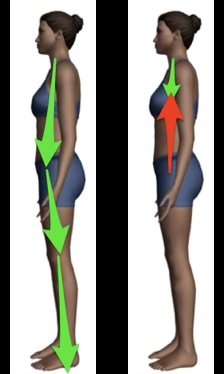
Energetically, all this requires what I call “downward flow” of energy. Our most challenging emotions, as far as grounding is concerned, are sympathetic nervous system-based, which create an upward flow of energy. Fear is a good example: we gasp and inhale or hold our breath, and pull upward, away from the feeling the rising in our torso. Up and away from the ground. See Figure 1.
The problem-
The usual grounding methods teach you to sense and breathe downwards through the front interior of the body to find your way to your feet and the ground. This works great… until you really need it! The rising sensation of emotions are sensed in the front and visceral core of the body. Grounding through the front means we are fighting this rising energy and sensation, trying to push through them to find our way downwards to our feet.
Take a look at the emotions map in Figure 2. All of these difficult emotions are subjectively experienced as located in the visceral core, the frontal interior of the body.
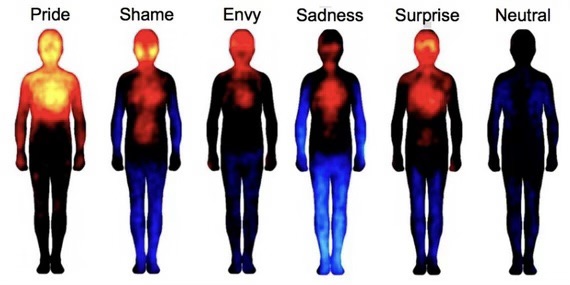
You can’t very easily ground yourself if you have to get to your feet through all that!
The Good News
The first good news is that there is a natural pathway that connects through the whole length of our body from head to feet, that has very little felt-emotio, but has ample sensation to it- the whole back line of the body. Take a look at the image in Figure 3 showing the major nerves in transparency. These are the biggest nerve pathways of the central nervous system, the brain and spinal cord, and the sciatic nerves in the legs. Now, imagine this pathway open and available to energy flow and, most importantly, to awareness and body sensation. They are like pipelines to spread awareness through the whole length of the body.

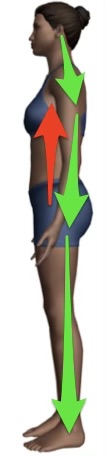
Now we would have an available continuity of awareness, energy flow, and body sensation all the way from head to feet that does not go through the emotional visceral core, as seen in Figure 4. This way, we don’t have to fight the emotional sensations in the front of the body to get to the support of the ground!
Another piece of good news: using subtle energy from our hands, we can generate a downward flow through these nerves that makes this path of grounding much more accessible to the clients awareness and more readily stimulated by breathing and imagery exercises.
Clients can be helped to find this pathway by coaching them to use imagery and breathing, without the hands on energy work. We do this by guided imagery and breathing, imagining their breath exhaling down their spine from head to sacrum, and eventually down the backs of their legs to their feet. I hope to post an audio of this process soon.
But, this process is tremendously improved by using hands-on energy work to open these channels through the nerve pathways. There’s not the space here to detail the basic process of generating and directing subtle energy here, but you can explore an audio meditation on this, called the “Coosh Ball Meditation“ and also see my article on energy and awareness.
The sequence is to send energy through the nerves from the upper hand to the lower section by section, as illustrated in Figures 5&6: neck to mid back, mid back to sacrum, sacrum to each hip joint, hip joint to back of knee, knee to back of ankle, and foot. This is done while verbally coaching aligned imagery for breathing and imagery with this.
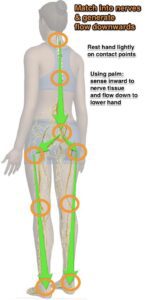
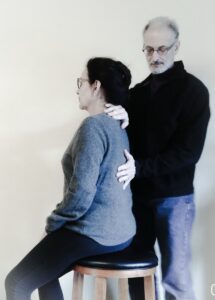
Repeated instances of this makes for more ease and speed in grounding through the backline for clients. It seems to clear and open a greater pathway for energy and sensation.
Rather than avoid emotions or situations, clients say that they can ground and feel emotion at the same time. I like to say that they can feel bigger than the emotion inside them, rather than the emotion feeling bigger than them. The emotion is something inside a much greater sense of themselves.
Look again at Figure 4. You can see how this is literally true. If you feel yourself to be as big as the green, and the emotion you are dealing with is the red, then you are indeed bigger!
Copyright 2026, James I Kepner, all rights reserved.
No part of this publication may be reproduced, distributed, or transmitted in any form or by any means, including photocopying, recording, or other electronic or mechanical methods, except allowance is made for ‘fair use’ under Copyright Disclaimer under section 107 of the Copyright Act 1976, for purposes such as criticism, comment, news reporting, teaching, scholarship, education.